Foxconn’s Silent Reckoning: From Assembly Lines to AI Backbone | $FITGF
In the high-stakes arena of AI infrastructure, where hyperscalers are pouring hundreds of billions into data-center buildouts, one name keeps surfacing in the most strategic deals yet rarely commands the multiple it arguably deserves: Foxconn.
Traded over-the-counter as $FITGF (with its parent Hon Hai Precision Industry listed as TW:2317), the company is no longer the pure-play iPhone assembler of legend.
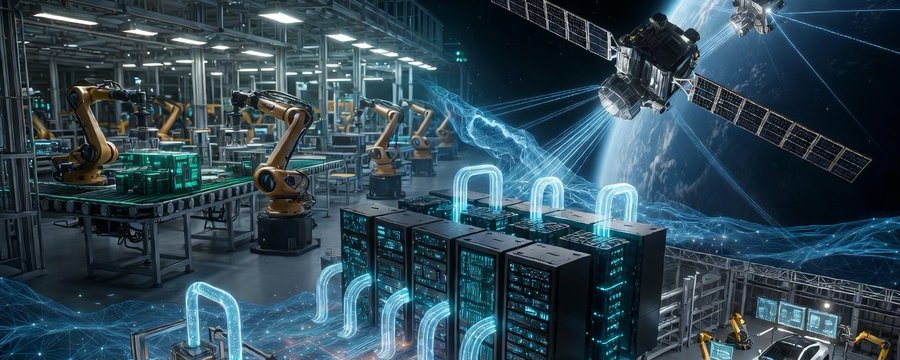
It is quietly positioning itself as a full-spectrum AI infrastructure manufacturer: servers, racks, interconnects, and even the orbital connectivity layer that will keep tomorrow’s models talking to the edge.
In 2025, revenue rose to US$5.0B from US$4.45B in 2024, with cloud revenue up from US$590.7M to US$813.0M and smartphones declining from US$942.9M to US$824.3M.
The latest moves, coming in rapid succession in spring 2026, signal that Foxconn is no longer preparing for the AI wave. It is already riding it.
Consider the scoreboard. In the first four months of 2026, consolidated revenue approached US$95 billion, with April alone hitting NT$832 billion.
Cloud and networking products, code for AI servers and the high-speed interconnect fabric that makes them hum, are the clear accelerant. Q1 revenue jumped nearly 30% year-over-year, and management has guided for continued sequential and annual growth in Q2, explicitly citing AI server racks.
Chairman Young Liu has laid out a five-year AI transformation plan that targets steady double-digit top-line growth for the full year, with internal targets reportedly eyeing NT$1 trillion in annual AI-server revenue. That is not incremental; it is structural.
The news flow this month alone reads like a tech-industrial manifesto.
On May 3, Hon Hai successfully orbited two second-generation Pearl-1A and Pearl-1B satellites via SpaceX Falcon 9. Equipped with Ka-band inter-satellite links and ionospheric probes, they are testing the very mesh networks that could underpin low-Earth-orbit (LEO) connectivity for industrial IoT, direct-to-cell, and – crucially – low-latency data pipelines for distributed AI inference.
This is not hobbyist space tech, it is closed-loop iteration from first-gen Pearl satellites completed earlier in 2026, leveraging Foxconn’s legendary system-integration muscle.
Simultaneously, Foxconn deepened its automotive bet. A new EV manufacturing hub with ElectroMobility Poland (EMP) in Jaworzno will produce three European-branded EVs starting 2028, complete with AI-enabled factories emphasizing cybersecurity, data management, and supply-chain digital twins.
A memorandum of understanding with Mitsubishi Electric, signed in late April, eyes a potential 50% stake transfer in Mitsubishi’s automotive mobility unit to jointly develop electrification, autonomous-driving, and software-defined vehicle platforms, exactly the kind of high-margin, high-tech adjacency that plays to Foxconn’s EV platform expertise via its Foxtron joint venture.
And then Japan: SoftBank is in active discussions with Nvidia and Foxconn to build “made-in-Japan” AI servers, aiming first for local assembly of imported components and eventually full domestic production by decade’s end.
For a nation obsessed with technological sovereignty, Foxconn’s role as the scaling partner is telling.
At roughly 3.47 trillion TWD market cap for the parent (~US$108 billion equivalent) and a forward P/E hovering around 18–19x, Foxconn trades at a noticeable discount to the pure-play AI infrastructure frenzy.

Support Independent Bitcoin Infrastructure
Support the ongoing operation of the X4A Bitcoin Full Node and help strengthen independent Bitcoin infrastructure. Selected options include personalized sponsor recognition.
Explore SponsorshipCompare that to Super Micro Computer $SMCI, whose water-cooled AI racks have made it a poster child for the boom, yet SMCI’s own governance noise and customer concentration have left it far more volatile.
$DELL and $HPE, the traditional server incumbents, carry higher multiples but lack Foxconn’s unmatched contract-manufacturing scale and vertical reach into precision interconnects (via subsidiary FIT Hon Teng, the very $FITGF ticker many U.S. investors trade).
Even versus TSMC $TSM, whose foundry dominance is unquestioned, Foxconn offers something rarer: the ability to ship complete, rack-ready AI systems at volume while also expanding into the orbital and automotive layers that hyperscalers will eventually need.
Why the discount? Markets still bucket Foxconn under “old-economy assembler” with lingering China/Taiwan exposure.
The iPhone business, while still substantial, is now overshadowed by cloud growth in the narrative. Overseas revenue from units like Foxconn Industrial Internet already exceeds one-third of certain subsidiaries’ totals, with Mexico plants and new European/Japanese footprints visibly de-risking the story.
Geopolitical volatility in the Middle East is the only cloud management has flagged, yet AI demand has so far proven remarkably resilient.
Foxconn is not merely supplying AI, it is building the physical substrate.
Its deep, long-standing ties to Nvidia $NVDA (servers, rack integration, even early humanoid-robot deployment at U.S. factories) give it preferred access to the GPU ecosystem’s highest-volume customer.
Add FIT Hon Teng’s connectors and high-speed cables, the invisible plumbing inside every rack, and you have end-to-end control that few competitors can match.
The satellite constellation points to a future where AI training clusters in the desert or Arctic need resilient, low-latency global backhaul. The EV pivot, backed by actual manufacturing hubs and alliances, diversifies revenue while capturing the software-defined vehicle wave that will itself run on edge AI.
In short, Foxconn is becoming the quiet indispensable layer between chip designers and deployed intelligence.
That is the definition of infrastructure in the AI era.
Now what ? Watch for three catalysts.
First, sustained AI-server momentum through 2H 2026 could push full-year guidance higher, forcing analysts to re-model the mix shift away from consumer electronics.
Second, any tangible milestone on the SoftBank Japan project or Mitsubishi stake transfer would validate the high-tech pivot and open new margin pools.
Third, incremental satellite constellation announcements could spark the “space-AI” narrative that has so far been reserved for pure-play satellite operators.
If the market begins pricing Foxconn on a 25–30x multiple, perfectly reasonable for a company whose core growth engine is now AI infrastructure rather than legacy assembly, the upside from current levels is material.
$FITGF’s OTC liquidity is thin, but the parent’s Taiwan listing already reflects early recognition: shares are up modestly YTD while the broader narrative has yet to catch the full acceleration.
Foxconn is not the flashiest name in AI … yet.
It is, however, one of the most engineered.
In an industry that rewards those who can actually build at planet scale, that engineering edge is becoming the hottest ticket in the house.
NFA. DYOR. E&OE.
Market data displayed by TradingView. Market data may be delayed.