Palantir’s Financial Dominance Exposes Wall Street’s Costly Obsession With Foundational-Model Hype
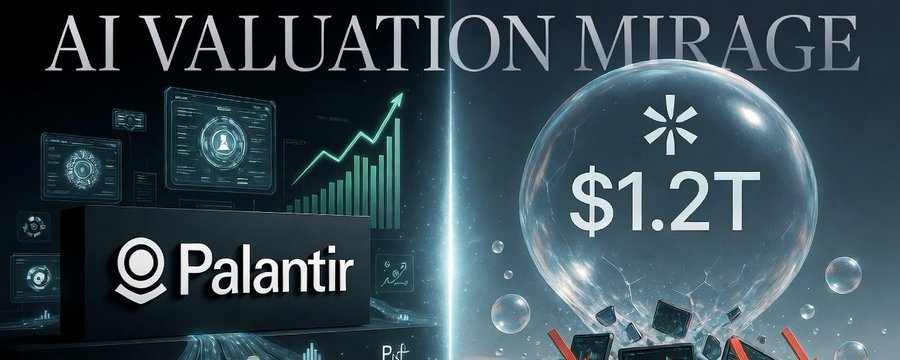
(crocon-media, May 6 2026, msc) The AI Valuation Mirage: Palantir’s Financial Dominance Exposes Wall Street’s Costly Obsession With Foundational-Model Hype
In the frenzied theater of artificial intelligence, private valuations have reached levels that would make even the most seasoned venture capitalist blush.
Anthropic, the maker of the Claude family of models, is now being discussed in secondary markets and investor circles at implied valuations approaching, or in some cases exceeding, $1.2 trillion, built atop a roughly $30 billion annualized revenue run rate as of April.
That works out to a clean 40 times revenue.
Meanwhile, Palantir Technologies $PLTR, the public company whose Artificial Intelligence Platform actually embeds AI into mission-critical operations for governments and enterprises, sits at a market capitalization of approximately $326 billion, despite delivering financial results that make Anthropic’s numbers look almost quaint by comparison.
The disparity is not merely striking … it is, on the numbers, indefensible.
Palantir’s first-quarter 2026 results, released just days ago, showed revenue of $1.633 billion, up 85 percent year-over-year, the fastest growth rate since the company’s direct listing.
U.S. revenue surged 104 percent.
U.S. commercial revenue exploded 133 percent.
GAAP net income reached $871 million, delivering a 53 percent net margin.
Adjusted operating margin hit 60 percent.
The Rule of 40 score, a benchmark blending growth and profitability, clocked in at an astonishing 145 percent.
For the full year, the company raised guidance to $7.65 billion to $7.66 billion in revenue, implying 71 percent growth, with U.S. commercial revenue alone expected to exceed $3.224 billion (at least 120 percent growth).
These are not the financials of a company “punished” by the market.
These are the financials of a company that has built the rarest of combinations in enterprise software: accelerating growth, eye-watering profitability, and a durable competitive moat rooted in its proprietary ontology and data-integration capabilities.
Palantir does not sell access to a large language model.
It sells decision advantage, software that turns messy, real-world data into operational outcomes for the world’s most demanding customers, from intelligence agencies to Fortune 500 boardrooms.
Contrast that with the “easy-peasy AI stack” currently commanding trillion-dollar whispers.
Anthropic’s revenue run rate, while impressive in its own right, reflects a business still heavily exposed to the brutal economics of foundational-model training and inference.
The company’s path to profitability remains opaque, its valuation rests almost entirely on hype, strategic investor FOMO, and the narrative that whichever lab produces the next frontier model will own the future.
Wall Street, and the private-market crowd that sets these prices, appears willing to pay almost any multiple for that narrative, while simultaneously discounting a public company that has already proven it can convert AI into durable, high-margin cash flows.
To put it in plain valuation arithmetic: Apply Anthropic’s own 40-times-revenue multiple to Palantir’s 2026 guidance and you arrive at roughly $306 billion, essentially where the stock already trades.
Yet Palantir’s superior margins, proven execution, and technological differentiation argue for a substantial premium, not a discount.
A company generating 53 percent net margins and 85 percent growth does not deserve the same revenue multiple as a high-burn foundational-model shop.
Reasonable analysts could easily justify 60 to 80 times forward revenue for Palantir, implying a fair market capitalization north of $460 billion, and quite possibly higher.
Instead, Palantir’s shares have suffered, as investors rotate out of what they perceive as yesterday’s AI winner into tomorrow’s private-market darlings.
The irony is thick.
Wall Street is not merely missing the story, it is actively punishing the company that has written the clearest chapter yet on how to make AI pay, while writing blank checks for the companies still figuring out how to make AI work.
The market, as it so often does, will eventually correct.
But in the meantime, the gap between Palantir’s demonstrated financial excellence and its current valuation stands as a textbook case of narrative over numbers.
For investors still capable of reading an income statement, the opportunity is staring them in the face.
NFA. DYOR. E&OE.
Market data displayed by TradingView. Market data may be delayed.