The Recurring Narrative of “Abandoned” Sectors, and the Leverage Cycle the Fed Enables
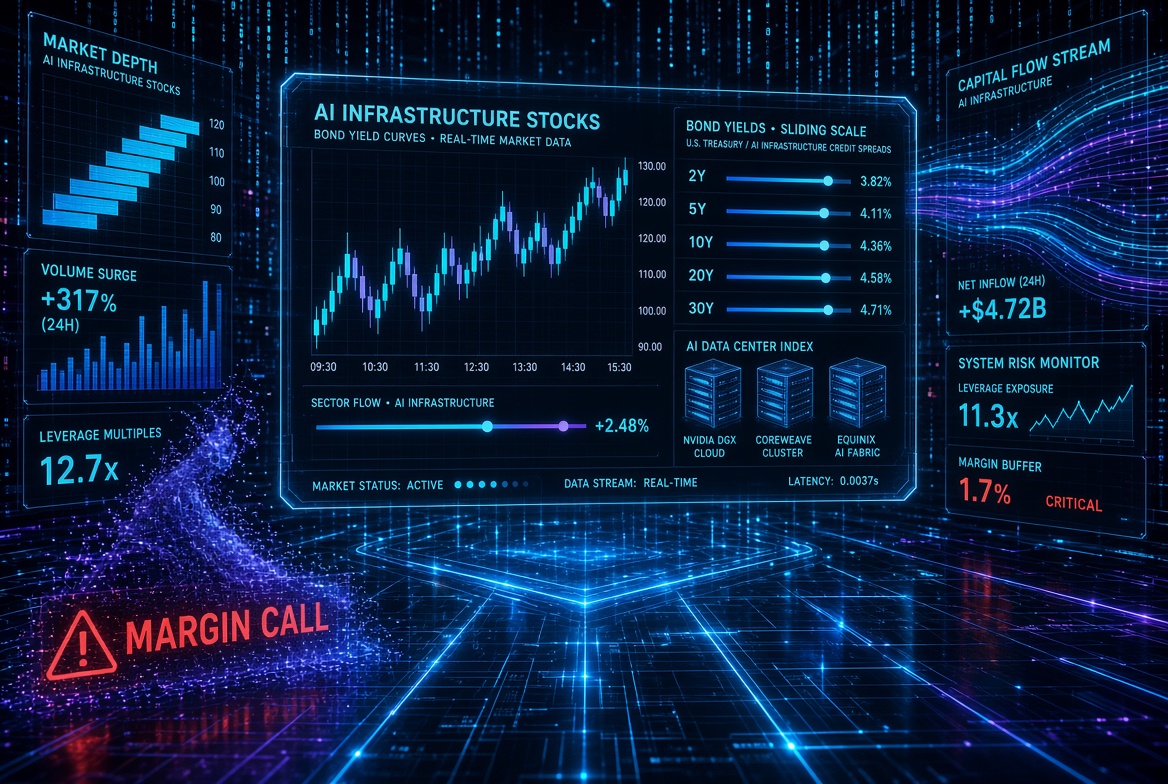
(crocon-media/X4A, msc, Oct 17, 2026) Every few months the same script returns with fresh costumes. Investors are “dumping” this or that sector. Capital is “fleeing.” Entire industries are suddenly declared uninteresting, overbuilt, or destined for write-downs. The latest version centers on AI infrastructure debt: bonds financing data centers trading below par, CoreWeave paper sliding under 80 cents on the dollar with yields approaching 15 percent, and forecasts of multi-trillion-dollar shortfalls between expected revenues and the capital already committed. Media coverage amplifies the story with the usual urgency. The implication is clear, smart money is walking away, and the rest should take note.
Look closer and a more prosaic pattern emerges. The typical retail participant, particularly the younger American investor who discovered markets during the post-2020 liquidity boom, routinely operates beyond his means. An all-in, all-or-nothing mentality often prevails: positions are sized for maximum upside rather than survival, and the distinction between investment capital and everyday cash is blurred. In extreme cases, credit cards become funding sources, turning high-interest consumer debt into leveraged market exposure. Four-times leverage is not exotic… it is the baseline for many. When volatility arrives, those positions are liquidated, not because the underlying thesis has permanently collapsed, but because margin calls and payment deadlines leave no alternative. The forced selling cascades through crowded trades, depresses prices, and generates the very headlines that reinforce the “abandonment” narrative.
This cycle does not arise in a vacuum. The Federal Reserve enables it. Prolonged periods of low rates, abundant liquidity, and the repeated message that policy will cushion downside risks encourage precisely the behavior that amplifies both the upside excess and the subsequent forced liquidations. Cheap funding and the expectation of backstops lower the perceived cost of leverage, making four-times exposure, and even credit-card financing, feel routine rather than reckless. When the inevitable shake-out arrives, the same policy backdrop that inflated the positions helps ensure the capital simply rotates rather than permanently exits.
The media and online echo chambers reinforce the pattern. Mainstream voices, including high-profile figures such as Jim Cramer, often shift tone with the price action, lending institutional weight to whatever narrative is currently dominant. Meanwhile, private communities on Reddit and Substack newsletters written by self-styled analysts amplify the same signals. These forums reward conviction and urgency… measured risk management rarely trends. The result is a feedback loop in which leveraged retail flows, media framing, and community consensus move in lockstep, first inflating positions, then accelerating the forced exits that create the next “sector abandoned” storyline.
Yet the forced selling rarely equates to permanent structural failure. Consider Nebius Group. The AI cloud provider has seen parts of its impressive run retrace amid broader infrastructure concerns and heavy capital-spending scrutiny. Still, its rapid revenue growth, expanding backlog, and strategic positioning suggest it remains a plausible long-term winner rather than a casualty. CoreWeave offers a sharper illustration of the same dynamic: the maximum-debt rider that has financed capacity as if there is no tomorrow. Its bonds have traded into distressed territory and its equity has been punished accordingly. Yet a contracted backlog measured in the tens of billions provides a path through which the company can still emerge as a winner if demand materializes as expected. High leverage accelerates both the upside and the periodic pain… it does not automatically invalidate the underlying business.

Support Independent Bitcoin Infrastructure
Support the ongoing operation of the X4A Bitcoin Full Node and help strengthen independent Bitcoin infrastructure. Selected options include personalized sponsor recognition.
Explore SponsorshipThe same logic extends further down the stack. Optoelectronics and advanced memory, particularly high-bandwidth memory, are becoming the new gold standard for AI systems. Their products sit at critical bottlenecks. Supply remains constrained by multi-year fab and packaging lead times. In such markets, who ultimately controls the price? The limited number of suppliers with qualified capacity. When availability is tight and demand is structural, pricing power accrues to those who can deliver. Temporary pullbacks in these names often reflect the same leveraged retail dynamics rather than a sudden surplus of critical components.
“Be greedy when others are fearful” remains sound advice precisely because fear is frequently manufactured by forced liquidations rather than by lasting changes in fundamentals. The periodic shake-outs create entry points for patient capital. At the same time, the ecosystem depends on the foot soldiers. Without the retail flows that generate the hypes, the narratives, the crowded trades, and the subsequent liquidations, the volatility that professionals harvest would be far more muted. The retail participant both fuels the boom and supplies the dislocation.
Professional dealers in covered calls and puts sit on the other side of much of this flow. They supply liquidity, collect premium, and manage risk with far tighter constraints and deeper capital. The shake-outs become orderly opportunities. Prices move to levels that attract patient capital. The foot soldiers leave their money on the table… the professionals pick it up. This cycle repeats across energy, semiconductors, software, AI infrastructure debt, optical components, and memory, each time facilitated by the monetary conditions the Fed maintains and the cultural incentives that celebrate maximum conviction over durable positioning.
None of this denies genuine questions about capital intensity, circular financing, or the gap between projected AI service revenues and the infrastructure required to support them. Those issues deserve scrutiny. What does not deserve uncritical acceptance is the framing that presents every bout of selling as a structural verdict on an entire industry. Forced deleveraging driven by overextended retail participants is not the same as fundamental reassessment. One produces temporary price dislocations… the other produces lasting change. Markets are very good at confusing the two when leverage is widespread, policy continues to underwrite it, and both traditional media and online communities eagerly supply the narrative soundtrack.
The result is familiar: another round of narrative reinforcement, another wave of retail capitulation, and another set of entry points for those who understand the difference between distress and opportunity. Life, as they say, remains rather beautiful for those positioned on the receiving end of the forced flows.
Market data displayed by TradingView. Market data may be delayed.