Foxconn’s Quiet Pivot: From “iPhone Factory” to AI Lasers, Silicon Photonics,and Plumbing of Compute
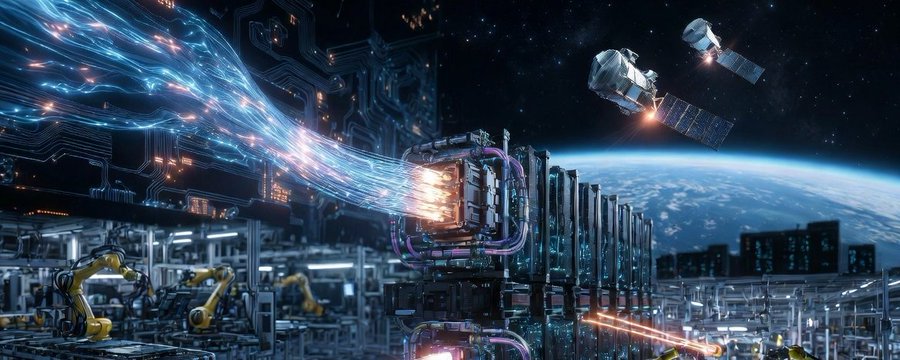
(crocon-media, msc, mschro, May 10 2026) For most investors, Foxconn’s AI narrative still reads like a familiar contract-manufacturing upgrade: less consumer electronics cyclicality, more hyperscaler server volume. That’s true, and it’s already showing up in management commentary and profit mix as Hon Hai leans harder into AI-server demand and US capacity build-outs.
What’s been easier to miss is the second transformation happening in parallel: Foxconn is positioning itself not just as a builder of AI boxes, but as a supplier of the optical and laser interconnect stack that makes AI clusters scale in the first place.
Step 1: AI factories, not just AI servers
Foxconn’s messaging has shifted from “we can manufacture your servers” to “we can deploy your AI infrastructure fast”. At NVIDIA GTC 2026, Foxconn showcased modular data centers with advanced liquid-cooling architectures designed to “decouple compute from power and cooling” so AI capacity can be replicated quickly and scaled globally.
This matters because the AI buildout is increasingly constrained by deployment speed, power delivery, cooling, and the ability to operationalize clusters reliably. Foxconn is explicitly selling itself as an “AI factory” integrator, not a commodity assembler.
Step 2: The overlooked move, lasers and photonics for the AI I/O wall
Here is the part the market often underweights: AI scaling breaks on interconnect.
As training clusters push toward next-gen switch fabrics (moving beyond 51.2T toward 102.4T), the bottleneck shifts from raw compute to the bandwidth/power/thermal reality of moving data across racks, pods, and data halls. The industry response is accelerating adoption of co-packaged optics (CPO) and tighter optical integration.
Foxconn’s subsidiary FIT Hon Teng (HKEX: 06088) OTC:$FITGF ISIN: KYG3R83K1037 has been rolling out precisely that stack:
- 102.4T CPO External Laser Solution: FIT says its platform hit key milestones and entered “ecosystem validation,” built around a modular, hot-pluggable external laser source (ELSFP) intended for serviceability in CPO-based systems.
- External laser upgrades aimed at CPO architectures: FIT also introduced an upgraded ELSFP module version designed for Tomahawk-6 CPO architecture, with higher output power per channel and support for 1.6T-class applications.
- From components to systems: FIT explicitly frames its evolution toward “integrated photonic–electronic–thermal system solutions” for next-generation AI infrastructure.
This is not a random adjacency. In the CPO world, lasers become platform-critical because optical engines move closer to the switch ASICs and the “old” pluggable optics model hits power and thermal limits. NVIDIA itself is publicly pushing the “photonics” direction with co-packaged optics positioning.
Step 3: Foxconn is building photonics R&D depth in-house

Support Independent Bitcoin Infrastructure
Support the ongoing operation of the X4A Bitcoin Full Node and help strengthen independent Bitcoin infrastructure. Selected options include personalized sponsor recognition.
Explore SponsorshipFoxconn’s Hon Hai Research Institute (HHRI) is not treating photonics as a marketing buzzword. Its Semiconductor Research Center lists silicon photonics and metasurface optics among core research areas, and HHRI describes silicon photonics development as a response to “mounting demand for high-speed data transfer” driven by AI and data centers.
That combination, production-scale interconnect manufacturing via FIT plus internal photonics R&D, is what makes the pivot strategically interesting: Foxconn is trying to own both the AI factory chassis and the bandwidth arteries inside it.
If AI is a gold rush, Foxconn is quietly moving from “selling shovels” to also selling the railroads and power lines. The market has already priced a lot of AI-server volume optimism, the less-discussed upside is that photonics and external lasers could become higher-value, more durable positions in the AI supply chain as clusters scale and copper runs out of physics.
In short: the “Foxconn AI story” isn’t only about server racks. It’s increasingly about the laser-powered photonic infrastructure that lets AI factories become real at scale.
Foxconn $FITGF HK:6088 ISIN: KYG3R83K1037 – FIT Hon Teng Limited, a subsidiary of the Foxconn Technology Group, is a global leader in high-precision interconnect solutions that is rapidly transforming from a traditional component manufacturer into an integrated provider of AI computing, mobility, and high-end connectivity systems.
Headquartered in Taiwan, the company serves as a critical partner in the electronics supply chain, specializing in the design, development, and manufacturing of connectors, cable assemblies, and optoelectronic products.
Strategic Transformation (The “3+3” Strategy)
As of 2026, FIT Hon Teng is executing a major transformation dubbed the “3+3” strategy, pivoting away from solely relying on consumer electronics to higher-margin, advanced technology areas. This transformation focuses on three key industries and three core technologies:
- AI & Data Center Connectivity: Leveraging its expertise to provide high-speed servers, 800V/1.6T high-speed connectors, liquid cooling, and 448G architecture for artificial intelligence infrastructure.
- Electric Vehicles (EV) & Mobility: Through its Voltaira brand and joint ventures, the company develops automotive wiring systems, connectors, and advanced mobility solutions.
- 5G AIoT (AI + Internet of Things): Expanding into 5G antenna modules, smart home devices, and acoustic components.
2026 Focus: High-End AI Infrastructure
By early 2026, FIT has solidified its position as a major player in AI infrastructure, with its liquid-cooling busbars and high-current connectors being integrated into NVIDIA MGX systems. The company has shifted focus to supplying complete solutions, including 224G+ sockets and co-packaged optics (CPO), designed to address signal degradation and heat management in modern data centers.
DYOR . NFA . E&OE.
Market data displayed by TradingView. Market data may be delayed.